
Bad Will Hunting

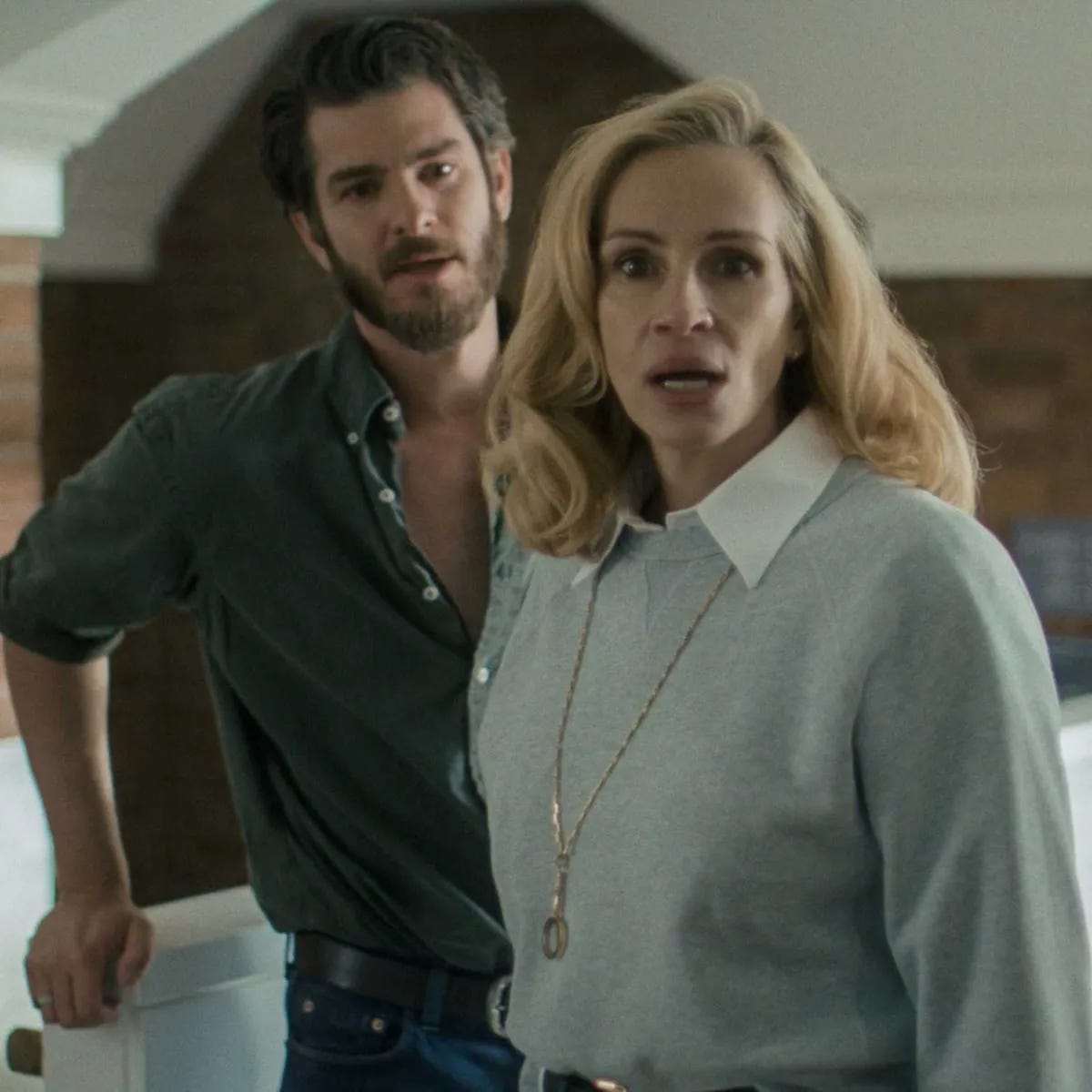
A second plane has hit Higher Education LLC, and that movie is Luca Guadagnigno’s After the Hunt. Since 2015, Guadagnino has managed to churn out a film almost every year. When he hasn’t made a movie, he’s done other things, like create an HBO miniseries that no one watched or talked about, or probably do something weird with his castmates offscreen. What After the Hunt has in common with that same miniseries, besides Chloe Sevigny, is that no one will talk about them. I am here to defy that prediction: After the Hunt and Eddington have seemingly been usurped by all eyes on One Battle After Another; while the latter’s discussion warms a culture devoid of important cinema, the two former titles are where the magnifying glass must be directed.
Guadagnino’s filmography is as fascinating as it is confusing. Challengers, the OBAA of last year, captivated American viewers for some reason I am still not sure of. Perhaps it was the teased hyper-sexuality that never fully emerged. Maybe it was most people’s introduction to nonlinearity, or French-inspired filmmaking, palatable to American audiences through the guise of Zendaya. There was 2022’s Bones and All, which, despite Timothee Chalamet as the enticing element, was—literally—dead and gone after its release (maybe the sophomore-slump between a Guadagnino and Chalamet collaboration, where a novelistic adaptation fell moot in Guadagnino’s using Chalamet as his second-time muse). After the Hunt has the most canonically star-stacked cast of all his filmography: an actress whose filmography proves exempt from any criticism of her performances, a universally-adored by teen girls and others British commodification, and newcomer Ayo Edebiri, whom you know from the ostentatious Bottoms or an FX series where Lip Gallagher from Shameless cooks and screams. Despite this, After the Hunt is the least palatable and least lucrative endeavor of all.
When Joan Didion said, “we tell ourselves stories in order to live,” the predominant opening words from 1979’s The White Album, she was talking about After the Hunt. The film follows the making of a career murderer, an ambiguously fabricated sexual assault allegation, an attempt to take down higher education and all its tenets with her. Edebiri plays Maggie Price, whose last name is more telling than any of her Big Little Lies. Roberts, during the film’s climax, says it best: she lives in an apartment far cheaper than what she could actually afford, dates a they/them for that sole fact alone whom she has nothing in common with, prancing around Yale University in clothes that, despite their “business casual”-effect—she also hilariously copies Roberts’ outfits, as she falls deeper in love with her—scream, not whisper wealth. You have a character who mentions endlessly that she is a “black woman,” that she has an axe to grind; yet she has no idea where to throw it. So what does she do? Wield those axes like she’s playing darts while drunk, hiding behind op-eds and news coverage, impervious to whose character she assassinates.
I both praised—and wordlessly questioned—the ambiguity of One Battle After Another, and its refusal to offer political insight. After the Hunt is seemingly hands-off in who it condemns, yet it leaves no cold stone unturned. You have Julia Roberts’ Alma, who shrieks for her latina maid named “Fabiola,” walking the halls of her colossal loft while smothering hand lotion in the way that only a white woman could do. Whether she, or Edebiri who is re-enacting a modern-day Basic Instinct with pronoun-policing and political correctness, is the movie’s “real” villain is unclear. You also have the accused: Andrew Garfield’s Henrik Gibson, a professor who can’t philosophize his way out of allegations, can’t flirt his way out of fallout. His charm ceases after Edebiri accuses him of raping her. We don’t see shots of him smoking a cigarette sullenly on the sidewalk. He charges into Roberts’ classroom, containing Edebiri as the sole spectacle like a raging bull, admonishing Roberts’ betrayal of him by “believing” Edebiri—which she never outright did. He looks at about 1% of Yale’s student body, which conveniently collect in the hall on that doomed day of his firing for dramatic effect and says: “fuck you! Fuck all of you,” tearing down posters of extracurriculars and kicking over a trash can. For Garfield, it seems, this is as far as he can react. For others, the unspoken rules are not quite the same.
The scene where Edebiri “confesses” to Roberts about her assault is determinably strange: she appears like a wounded puppy, rain-soaked in Roberts’ hallway, refusing to enter inside where her husband, a psychologist with a hi-Fi setup, a love for cooking and classical music, permeates ( During her confession, Edebiri self-edits in real-time: perfecting facial expressions and riding with the allusion of what she accuses. When Roberts’ character asks her to say it outright, she becomes vexed: “why do you need to know?” she asks, until further probed. The vacillating villainy here is interesting: Roberts’ character is both subject to condemnation for refusing to immediately “believe” the victim, yet her demand of specifics is something any reasonable person would ask for.
After the Hunt opens like a movie from 1976 that somehow got produced in 2025. The featured cast list telegraphs first, supporting players alphabetically organized like we’re watching Network, and for the first time in years, I felt feelings other than static. It feels decadent and beautifully nostalgic, an aesthetic choice that immediately tells viewers who flocked to see his last film: this is not Challengers. There’s no sweaty tennis or teen horniness here, no Reznor and Ross score, an aphrodisiac for hypersexual nonlinearity. This is somehow classical, compositional and intentional, making the ensuing chaos more of a violating treat. Guadagnino has stripped naked his usual gimmickry: the pornographic gaze of Call Me By Your Name, the blood and guts genre-fuck of Bones and All. What remains is something gelidly relentless, a tacit trigger warning for general audiences to strap in or leave.
The film’s first gathering, a professorial dinner party at Roberts’ palatial apartment establishes an ecosystem before predation rears its pretty teeth. Black African décor adorns the walls (of course it does; these are the kinds of academics who summer in Morocco and reenact John Williams with aspiration), and Edebiri’s Maggie stares at it with the suspicious gaze only a true predator could have. Someone who catalogs and compartmentalizes, scheming Didion-like in the corner. Except, unlike Didion, she doesn’t aspire to create—she wants to destroy. She’s already established as the pitbull-nose-ring anomaly in a room of tweed and theoretical posturing: the kind of student who wears her ostracization like armor before weaponizing it like a dagger.
The professors speak predictably in thesaurus words, “egoic” and “teleological” and it’s hilarious because it’s accurate. Those who lament the screenwriting’s overwrought quality are missing the point entirely. Just because something has the balls not to brand itself as immediately satirical doesn’t mean it can’t also be compelling and cathartic. Guadagnino isn’t mocking them: he’s achieving such a verisimilitude that it seems natural. Languid. Bored. And so, the talking heads speak with boredom, not with insight. These people really do talk like this. Garfield’s Henrik Gibson, still untainted by accusation, asks: “When did offering someone a drink become the preeminent cardinal sin?,” a throwaway line that will metastasize into the film’s central question: when did every gesture become an opportunity for prosecution? When did humanity become grounds for execution?
The dinner party devolves into the ideological performance art of gathered, self-proclaimed “academics.” A Gen Z Dimes Square dissident (yes, Guadagnino knows about Dimes Square, which he’s probably run train through) dressed like The Dare riles Roberts’ character into a rant about the performance of gender inclusion. “Tart break!” someone announces, desperately trying to diminish the caustic conversation developing, and it’s both absurd and perfect. It is a Tartt break: these “academics” act like the twenty-year-olds from Donna Tartt’s The Secret History, who think bureaucratic exclusion and reciting philosophy makes them interesting. These gatherings are never about camaraderie: they’re about the masturbatory pleasure of hearing yourself speak in theoretical language in front of an audience, none of which want to entertain you.
“Just because Maggie is gay doesn’t mean she’s in love with me,” Roberts tells her husband when the party dismantles, and it’s funny because it’s a lie she’s telling herself. Maggie is absolutely in love with her: not just sexually, but parasitically. She copies Roberts’ outfits, her mannerisms, her intellectual cadence, even her stupor. She’s studying her the way a sociopath studies normalcy, and as the film’s events prove: real recognizes real.
“Thank you for the lovely evening,” Maggie says before the fated night unfolds—or doesn’t. Roberts responds: “These things are never lovely, but you’re sweet to lie.” So why do them? Because academia is built on this kind of self-flagellation: the ritual of gathering over Jameson (when you’re not pretending to hate Jameson) to perform your politics, draw lines of allegiance in the sand and affirm that you are on the right side of history, even as it curdles in your hands.
When Maggie slips away from the fated dinner party, she snoops through Roberts’ medicine cabinet as if the Chekhov’s gun needs to be found and shot. It’s the ultimate Zoomer, Zendaya in Euphoria kind of move: the reflexive snooping, this sweeping violation of privacy—a topic to unfold throughout the film—disguised as Nancy Drew curiosity. But there is no “greater good” to be achieved here. Of course, everyone has done this at some point; we’ve all opened someone’s medicine cabinet to see what prescriptions and skincare products serve as the simulacrum for their interiority. But Guadagnino films it with the weight of Chekhov’s gun: she’s not just snooping, she’s gathering ammunition.
This is the miniature chihuahua-thesis the film has to offer: the barking, perturbing, inability to differentiate between intimacy and the gathering of schadenfreude artillery. Every confidence shared, vulnerability exposed or hidden becomes raw material for the storyline Edebiri writes. This is a one-woman show, and the audience members are just collateral damage. She’s on the hunt, she’s been hunting since the beginning, and everyone around her, these well-meaning, theoretically progressive academics are prey mistaking 21st century “girlbossery” for a wounded Bambi.
The line that exposes Maggie’s entire project to kill Garfield’s character comes midway through the film. During a conversation where she’s already begun orchestrating the media circus, the op-eds and the crowdsourced sympathy, she asks: “am I not owed this?” It’s supposed to sound like a question, but it’s not. Roberts knows this and so should we: it’s a mission statement.
“Owed.” The transactional, indebted language requiring care and compensation. Maggie has decided, somewhere in her unmedicated pathology, that the world “owes” her something. Not justice (she hasn’t been wronged), not “truth” (her character is a fallacy-feminist), but attention and validation. This is the cultural capital existing within 2025, where ‘V’ doesn’t only stand for ‘Vendetta’ but for ‘Victim’ with a capital V. Where trauma is the only currency that matters, where the endgame is monetizing academic, sexual and mental suffering before someone else GoFundMes their own.
When a reporter “coincidentally” approaches her, Maggie feigns shock: “I didn’t know they’d contact me,” she pleads, yet she’s been courting this trauma-queen throne from the beginning. She’s recreating Pretty Persuasion 20 years later, except Guadagnino refuses the safety of satirizing. He won’t let you laugh this off as “dark comedy:” he forces you to watch her manufacture her own malevolent trauma— “inadvertently,” she’d claim—yet there’s nothing inadvertent about it. She commercializes it through news coverage, probably wishing that Jezebel still existed and would switch from politically correct pastiche to cancelling philosophy professors.
She’s not just a Cliffs Notes scholar: she’s a Cliffs Notes human being. Roberts’ husband (the psychologist who is paid to see through everyone’s subterfuge for a living) questions her about her virtue ethics during a dinner at their home. She frenetically Zoomer-handles him, asking about how often he makes said dish. She can’t defend her intellect, can’t defend her status as a Yale student because her intellect doesn’t exist. Her intellectuality is strictly strategic. She has a degree in studying others, not to learn, but to locate their weak points. This is what I’d like to call selective neuroticism: she’s too nervous to watch paint dry but becomes ascetic when watching the clock tick. The husband knows it. The men in this movie know it. Because the men (Garfield’s disgraced professor and the psychologist husband) are the only ones not performing, the heroes, and the most radioactive thing about this movie, which is why no one will talk about it and why it currently occupies an abysmal critical reception, if that ever mattered.
Besides the ostentatious clock-ticking that perforates throughout the film—mirroring Edebiri’s proclivity to pounce—no other “needle drop” occurs. That’s why when one does: it’s more conspicuous than cancer. During a conversation between Roberts and Sevigny, “Heaven Knows I’m Miserable Now” plays at the bar. Guadagnino is not coy, monkey covering face emoji-evasive: he wants you to understand the film’s thesis. Chloe Sevigny, playing the school’s psychotherapist with pill-prescribing power (this is important), delivers the film’s most lacerating indictment: “What happened to stuffing everything down and developing a crippling dependency habit in your thirties[...]?”
It’s funny because it’s true. It’s devastating because it’s the film’s generational divide explained within a single sentence. Sevigny’s character represents the old guard: suffer privately, self-medicate and refrain from making your “mental” everyone else’s. Maggie represents the new and unimproved model: weaponize everything, perform your pain, demand the world rebuild itself around your specifications or be condemned as complicit in your suffering.
“I thought you should be ready. For backlash,” Sevigny tells Roberts who, at this point, has done literally nothing. She hasn’t publicly supported Maggie nor denounced Henrik. She’s done what any reasonable person would do: asked questions, demanded specificity, refusing to “believe” as if belief were a moral obligation rather than a cognitive process. But in 2025, neutrality is violence. “Not using your voice?” A knife through the rib. Being on the “wrong side”—or, more accurately, not performing your allegiance to the “right” side loudly enough—is the cardinal sin. What about forensic fabrication? What about the lives that crumble? The film’s fruitless “twist,” which I will not pay much attention to, reveals a similar allegation Roberts fabricated resulting in a man’s suicide. What about that? Those questions aren’t allowed in the discourse. Ask them and you’re a rape apologist. Ask them and you get what Roberts does when she just can’t take it anymore: heckled and hospitalized.
Pre-hospitalization: Roberts finally snaps. It occurs in the classroom, appositely, the only arena left where ideas are supposed to matter more than identities. Except they don’t. “What could make you happy?” she asks her students during a blurry, masturbatory debate where the “Other” becomes a politicized being rather than a hypothetical. “Should we build society to your specifications? Padlock it with fucking trigger warnings? That is not what I’m here for. I’m here to fucking teach.”
Roberts faces one battle after another. Maggie’s disciples, her sweater vest-wearing, bleached mullet-having, they/them surrounding pack of vicious alpacas have turned Yale into a tribunal, and Roberts, exhausted, betrayed and physically deteriorating, refuses to be contrite: “Don’t you have some obscure protest to go be publicly angry at? They, go away!” she screams.
In a confrontation with Edebiri, she shoots Chekhov’s gun: “you are the worst kind of mediocre student. With so much availability—[implying her clear-as-day “privilege,” manufactured “oppression]—but no talent or desire to do so.” She’s talking to Edebiri, but she’s talking to an entire generation that’s been coddled into believing their feelings are synonymous with truth, that their identities are immune to criticism, that their trauma is a shield against accountability. Maggie lives in an apartment far cheaper than what she can afford (Daddy’s money is fine if you perform poverty), dates a they/them not because of attraction but alliance, who parrots “black woman” like it’s a get-out-of-criticism free card despite her obvious class privilege: the embodiment of fraudulence. And beloved actor Julia Roberts has just said it out loud.
The alpacas attack Roberts. Not physically, they’re too trained for that, too “aware,” but with ideologies and iPhones, surrounding, filming and questioning her. They perform resistance with the choreography of TikTok therapists pontificating about “mutual aid” and “holding space.” And what “resistance” does that cause? Malignant recrudescence.
The next scene shows Roberts in a hospital bed, body literally rupturing from amalgamated ambiguous illness and the stress of ideological warfare. This is what After the Hunt hunts after: the adversary that activism can be when it disrupts things further than ideological conversations and social strata. It becomes physical violence. It hospitalizes people: killing them slowly, then quickly, then slowly again.
The vacillating green and red light in the hospital room is Fitzgeraldian: the American dream does not exist, nor can it, when the social contract has been replaced by a system where accusations are convictions, where feelings are facts, and when the mob adjudicates guilt before evidence enters the room. The dream is so far out of bounds that society, here, seems unsalvageable. Movies like this don’t fix that, but at least they say something. At least they hunt, and we are left to gather the bodies.
Maggie isn’t done. She never is. People like Maggie who learn that trauma is the only lingua franca that matters in 2025 don’t stop when they destroy one life, they pivot and find a new angle. When the allegations against Henrik lose steam after her successful burial and woke-wake, when people ask inconvenient questions about timeline and evidence, Maggie shifts tactics. Suddenly, it’s no longer about sexual assault. It’s about race. “I am another black woman who was failed by a white woman,” she says.
Never mind that Roberts asked for specifics, refused to rush judgment, treated the allegation with the solemn contemplation it deserved. Never mind that Maggie herself is the heir of wealth, that her race and gender have never prevented her from accessing Yale or fancy apartments or cultural capital. None of that matters. What matters is the narrative, and the narrative is existential and malleable if you know which buttons to press. Here, identity is not a fixed category: it’s a closet full of weapons and skeletons. Which subcategory of Edebiri’s identity that she can excavate via media access and the support of Yale’s student body is “trendiest?” She will pick up and put down whichever part of herself will do the most damage in the moment. Maggie doesn’t experience oppression, she deploys it. She’s a chameleon of “causes” because she can’t even stick to one victimhood; instead, she shapeshifts between “survivor” and “black woman failed by feminism” and “intelligent student demeaned by psychoanalyst husband who sees through my bullshit.” And it works. Of course it works. It’s 2025, the social game is rigged in favor of whoever can claim the most intersectional victimhood. Do I lose social capital because in the eyes of Instagram activists, Palestine has been “solved?” How long will my sympathy last?
In the hospital, Roberts tells her husband the truth about her own teenage sexual assault: not a sexual assault, a fabricated story of reverse-Lolita. She became entranced with her father’s friend and began a sexual relationship with him. When he dated someone his own age, she fabricated a rape allegation. Then, years later, he killed himself. Frederik, the psychologist husband who “sees through it all” tells her what she doesn’t want to hear: “Even if you feel that way, what happened was statutory rape.”
The film doesn’t let the revelation redeem Roberts or condemn her. It’s not a twist: it’s a mirror. Guadagnino is showing us that the cycle of fabricated allegations, of weaponized victimhood, of destroying lives through narrative manipulation: none of this is new, it’s generational. It’s economical, it’s a trickle-down effect. Roberts did it decades ago, Maggie does it now, and someone will do it tomorrow because there’s an incentive and a structural reward. The difference is that Roberts carries guilt. Maggie feels nothing. She’s moved on, extracting the knife while the body is still warm. Yet she’s cold as ice.
Roberts meets Maggie for the inevitable reconciliation, the fated “catch-up.” She’s broken up with her they/them and shows her a picture of her new girlfriend. Roberts is now dean and has published an article adopting Frederik’s language about her “statutory rape.” It rehabilitated her career. Maggie is thriving. She’s moved on. She’s happy, seemingly, which is the same thing in her own world.
“You’re not really happy,” Maggie says to Roberts. “And that article? Cynical as fuck.”
She’s right, but then she adds “it doesn’t matter to me anymore.”
It never mattered to her. Not Roberts’ pain, not Henrik’s destruction, not the collateral damage of her fabrications. She extracted what she needed and walks away with the bloody tools used for incision. Attention, validation, the brief dopamine hit of being queen of discourse, and moved on. She’s a locust: consuming everything in her path and flying to the next field.
Roberts pays. The camera lingers on the twenty-dollar bill. It buys our drinks, and sometimes, our silence.
The populace of the screening I attended was entirely Gen Xers and above, not one colored hair of head in sight. Not one Zoomer or Millennial couple on date night, no college student dragged along by a film major roommate. Just boomers and Gen Xers, the people old enough to remember what movies could say when they didn’t have to affirm what you already believe.
After the Hunt, will and has already bombed. It will disappear as quickly as it was released. The discourse will ignore it in favor of whatever Netflix true crime docuseries is trending, whatever “elevated horror” provides aesthetic catharsis without thoughtful provocation. And when it does get discussed, it will be called “conservative,” “reactionary,” “insensitive,” all terms we use now to avoid engaging with anything that complicates our tidy narratives about victimhood and villainy.
You’ll think it’s making fun of you, and you’re exactly right: that’s why you should see it. But when Bodies Bodies Bodies, an A24 horror-comedy, and one of the only generationally astute movies capturing Zoomer zeitgeist of the last ten years was received terribly, why should we expect this movie to perform better?
So, when Joan Didion said, “we tell ourselves stories in order to live,” she didn’t mean assault fabrications. She meant the anomalous film like this one. There’s no artistic chutzpah here, no flashy Guadagnino tricks to distract you from its thesis, just clarity and cruelty. Just the hunt, and the bodies left behind, the knowledge that someone tomorrow will pick up the axe or the double-barreled gun, break down the barricaded door, shooting us in our sympathetic hearts while trusting we handle their truth.